NOTE: This is essay was one of my assignments for my current graduate course as part of a Masters of Arts in the Great Books I’m slowly pursuing through the online Memoria College entitled: “Man in Society: The Development of Political Theory”
Week 7
As I read through “The Prince” by Niccoló Machiavelli for the second time in my life, it was the written words of U.S. President Abraham Lincoln that resonated in my mind. Would it be plausible that Machiavelli and Lincoln could be friends if they lived in the same lifetime together?
I humbly propose that there are enough overlapping sentiments in their respective philosophies regarding how a leader should glean various opinions of counsel to make executive rulings or decisions that support the fantastic idea of their propensity to have been collaborative colleagues.
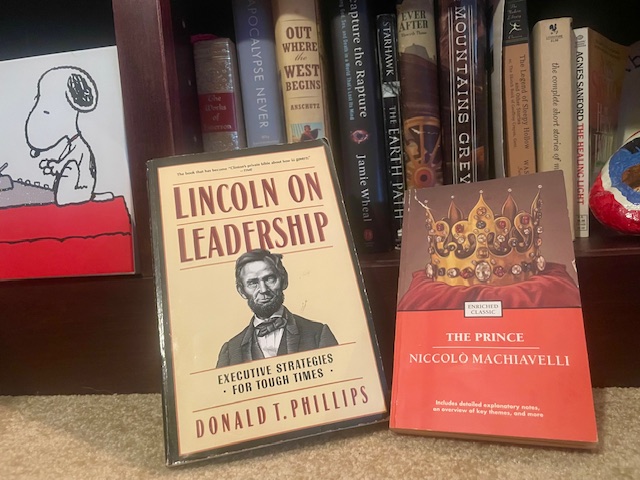
My methodology for this light inquiry will involve study of Machiavelli’s “The Prince” as well as a closer look at a collection of Lincoln’s words in Donald T. Phillips’ “Lincoln on Leadership” that was first published in the early 1990s that was once dubbed former President Bill “Clinton’s private bible about how to govern.” -Time Magazine
An appropriate starting point for Machiavelli’s work can be found in chapter 13 entitled “How Flatterers Should Be Avoided” where it is explained why it is crucial for a leader (in this regard, a “prince”) to seek the counsel of others beyond his “yes men”: “With these councillors, separately and collectively, he ought to carry himself in such a way that each of them should know that, the more freely he shall speak, the more he shall be preferred; outside of these, he should listen to no one, pursue the thing resolved on, and be steadfast in his resolutions; He who does otherwise is either overthrown by flatterers, or is so often changed by varying opinions that he falls into contempt.” (Chapter XXIII, pp. 33-34). This section in particular is fascinating because it can be interpreted that it espouses a prince should be open in his dealings with those who would counsel him on how to approach a particular subject matter but at the same time hold his opinions tight in silence—arguably allowing both factions of those who would speak flattering words to receive his good graces as well as those who are being disagreeable with him to be truthful. In other words, the prince who stays silent on which direction(s) he may follow will allow those who are jostling for his ear to feel more comfortable to be themselves, whether authentic or not.
How would Abraham Lincoln possibly interpret the theory of how to receive wise counsel when governing? “I shall do nothing in malice. What I deal with is too vast for malicious dealing.” – Lincoln’s comments in a letter about the readmission of Louisiana to the Union (July 28, 1862) from Lincoln on Leadership (p. 58, Phillips) In Chapter 5 of “Lincoln On Leadership”, Phillips sets forth the argument and explains that Lincoln was a remarkable leader because his personality was at its core committed to being honest, compassionate and having mercy—further, there are numerous examples in his public life of governance that reflected an ability to seem impervious to feeling hateful or vindictive toward others in general. “While kindness was the very foundation of his personality, Lincoln also understood that if people were going to come to him with ideas, suggestions, and better ways of making things work, he had to provide the climate to allow it. He actively encouraged innovative thinking and the participation of subordinates.” (p. 58 – 59)
President Abraham Lincoln held court with both his friends and his enemies during his tenure as U.S. president. In fact, some of his greatest accomplishments especially by way of correspondence and oratories were because of his interactions with those who vehemently disagreed with his personal philosophies as he led a nation throttled by the Civil War years in a still growing United States of America. In kind, Machiavelli also served during a tumultuous time in Italian history when early in his working years he was involved in the raising of a Florentine army only to be crushed publicly and privately when the Medicis came back into power in February of 1513.
The similarities diverge for both men when it comes to how they spent their post-career days, whereas Machiavelli was afforded the time to retreat, reflect and therefore write powerful books like “The Prince” and “The Art of War” to share with generations thereafter, Lincoln’s life was snuffed out in an instant in what is known as Ford’s Theatre in Washington, D.C. with only letters and eyewitness accounts to help share his servant leadership philosophy with history.
R.V.S.Bean
Bibliography:
Phillips, Donald T., Lincoln on Leadership: Executive Strategies for Tough Times. Hatchette Book Group, New York, NY.
Machiavelli, Niccolò. The Prince: Enriched Classic. Simon & Shuster. New York, NY
 CEO of the Home