January 4, 2024
A Simple Science Lesson: Painted by Poetry
In my home classroom this morning I introduced Walt Whitman’s poem “When I Heard the Learn’d Astronomer”:
When I heard the learn’d astronomer;
When the proofs, the figures, were ranged in columns
Before;
When I was shown the charts and the diagrams, to
Add, divide, and measure them;
When I , sitting, heard the astronomer, where he
Lectured with much applause in the lecture-room,
How soon, unaccountable, I became tired and sick;
Till rising and gliding out, I wander’d off by myself,
In the mystical moist night-air, and from time to
Time,
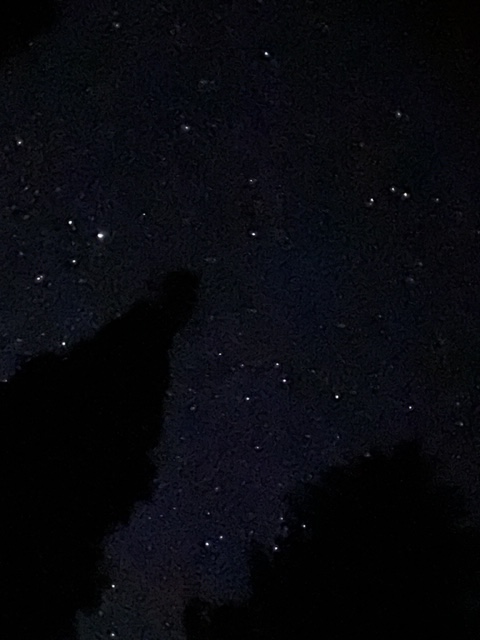
Look’d up in perfect silence at the stars.
https://www.poetryfoundation.org/poems/45479/when-i-heard-the-learnd-astronomer
After I read it aloud, I asked my students what their reflections were and the consensus was that there was fatigue, sadness and a feeling of being overwhelmed. I asked them if they feel bored, does a change of scenery help? In the case of this poem, was science more interesting to be experienced outside rather than just reducing it to a program of numbers and theses on paper? There was no wrong answer, I simply shared this poem and asked my children what they each perceived from it.
Outdoors as a Rule
We had a good discussion about it and led to me sharing that I had always approached our “snack/break time” with the mindset that they were to get outside and experience nature through their physical senses. Over the years I’ve consistently made it a rule that they cannot play with balls, toys and other items when they go outside for the 15-30 minute outside break from our homeschool inside. While they can learn all the theories, equations and use technology as a means to learning about the sciences, I’ve been firm that they must spend a structured amount of time in nature to interact and have no agenda other than to experience or observe the outdoors in as raw a form as possible.

Teacher Teaching What She Learned
I came across Whitman’s poem during my reading of “ A New Natural Philosophy” by Ravi Scott Jain, Robbie Andreasen and Chris Hall. The book examines how educators and administrators can approach “recovering a natural science and a Christian pedagogy.
Their research and reflection helps reveal that in human history there has been recurring habit of the “poetic notions of reality” which will occur prior to scientific arguments/experiments/hypotheses. An example of their research work reveals “a theory of the multiverse and one of evolution date back to the ideas of the ancient Greeks, as does heliocenterism. The pre-Socratic thinker Anaximander suggested that men evolved from fish and also claimed an infinite number of universes were continually coming into existence and passing away. Natural scientists may talk about the multiverse, but they do well to recognize that they are participating in the very ancient discourse of natural philosophy: the love of wisdom regarding the natural world.” (13)
While “A New Natural Philosophical” is coming from a Christ-centered viewpoint, I believe that merely subscribing to an open, creative viewpoint can help the study of both science and growing technology by simply reflecting on artists like Walt Whitman.
Consider the online article by Maria Popova entitled “When I heard the Learn’d Astronomer: What Walt Whitman’s Timeless Reckoning with the Limits of Science:
“No literary artist has wrested grander themes out of the reality of the natural world, nor channeled those themes more beautifully, than Whitman, for whom astronomy was a particularly beguiling lens on humanity’s intimacy with nature. He lived through a golden age of American astronomy, when the first university observatories were being erected, when comet discoveries and eclipse observations regularly made the front pages of the nation’s newspapers. After astronomers at the U.S. Naval Observatory discovered the first moon of Mars, and soon the second, Whitman exulted in his notebook: “Mars walks the heavens lord-paramount now; all through this month I go out after supper and watch for him; sometimes getting up at midnight to take another look at his unparallel’d lustre.”’
Why Share This? Technology and Science are Constant Companions of our Children
At the writing of this, I’m a mother to an 8, 12 and 15 year old respectively, I can attest that my biggest priority over the years is to help encourage them that in the realm of the sciences there is so much to be questioned and learned.
I’ve often reminded them that even those who are scientists don’t know everything about their discipline or area of study. That’s something to be celebrated and to hopefully help inspire those students who may find particular areas of study to be interesting so that they can add their own contribution.
In the technology arena, along with my husband’s support we’ve kept them from over-indulging in things like touchscreens and easy internet searches in lieu of learning how to read, interact with others and cultivate their inner creativity so as to integrate better in a rapidly changing world as humans weave their existence with increasing tools of their own making like ChatGPT.
To be continued…after all, we’re all in “school” together on this Earth.
R.V.S.B.

 CEO of the Home