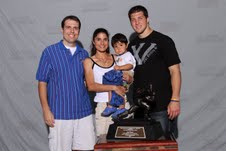
Florida’s QB Tim Tebow is the Real Deal

Go Gators!

On a lighter note, my husband, son and I had the joy of hanging out with hundreds of other Florida Gators at the Downtown at Palm Beach Gardens this past Saturday.

Tim Tebow was in town on behalf of his Foundation and in exchange for a fee you could get a personal autograph and/or photo with him.  $160 for autograph and $75 for a photo, some package deals available as well.  At first this seemed to be quite the stiff fee but then when I thought about it, I told my husband it probably would be a worthy cause and we’d have a fun photo in our family lore.

Initially I sent my husband and son T.A. to go get the ticket and planned that they would go together for the photo.  Once Saturday came around, however, I started to feel my Gator orange and blue pulse and wanted to be a part of it!

Our photo group ticket was scheduled for around 3pm, but when we arrived at the open court area we sensed that it may be a while longer.

It was a sight akin to a small carnival: there were tents with tables representing various local businesses, games and activities like a bounce house for the kids, guys walking around making balloon animals and orange and blue laden folks everywhere as far as the eye could reach in a 360 degree area.

We approached the line of being “on deck” waiting and found out that they were still working through the autograph groups (they were before the photographs).  Judging by the group number (3) for autographs and acknowledging that we were group 6 of photographs, we took T.A. and sought out the bounce house by A Latte Fun.

While helping our son mitigate the most adult-type of waiting time, we got to chat with other fellow Gators.  We began to hear all the stories that were already unfolding from events earlier that day.  There was evidently a Gator Walk where Tim Tebow walked for the Foundation along with other Gators and he was careful to make sure he greeted everyone in the group.  Those who had received autographs already were more than happy to wait for the photograph they also purchased because it meant sealing a great experience that had begun with a most personal autograph session.

The refrain we kept hearing was that Tebow was the “real deal”, he genuinely gave his attention individually to everyone, he helped people onstage, he had a great sense of humor as he gladly participated in fun poses with some people like doing a Heisman pose or faking a football move.

One story that made a national cable news hit this past Monday was about a guy who gave Tebow his engagement ring (which Tebow held for a good 45 minutes before the guy and his girl arrived at the head of the line). When the couple approached, Tebow literally pulled out the ring box and opened it in front of them. The girl dropped her mouth as her boyfriend dropped to his knee and proposed to her in front of Tebow.  Of all the shouts and whoos we heard that day, it was the loudest feedback from the crowd when this couple and their engagement was performed in front of Tebow. The jokes were consistent afterwards that they should have just had Tebow preside as minister for an impromptu wedding ceremony while they were at it!

It was nearly 7pm by the time our photo group finally was ready to be seen for a photograph with Tebow.  Mind you, the event itself was supposed to last from 1-5pm that Saturday.  Thankfully, Tebow was determined to honor all tickets and even though you could tell he was getting a little tired, he had hardly taken any breaks during the day-he is a strong football player and could see a prolonged autograph/photo session through.

Our son T.A. was also a trooper. We’d exhausted all the kid activities, most tents were now gone, the kitchen store Sur La Table had witnessed our presence multiple times (I bought some measuring cups on sale to at least say thanks for tolerating my pot and pan fanatic son), we’d treated him to some chamomile tea and even ice cream.  We’d continued to show him the lines, the stage where the action was at and every time we mentioned Tim Tebow, he’d point to the football posters abounding in that area and say “boom!” while pushing his hands forward in an almost tackling motion.

We made it to the front finally and Tebow warmly greeted us. I had brought my Gator cross-country and track gear and greeted him as a fellow jock. T.A was placed next to him in my arms and we had a couple of photos taken. We noticed that the photographer was very nice and attentive to our son which we appreciated as we knew this guy had the longest day of work going on as well. We shook hands with Tebow again and congratulated him, I thanked him for being a great Christian witness and he was very humble in his gracious response.

Yes, Tim Tebow is the real deal. We wish him the best in all his endeavors, whether they be football, people, family and life in general.

RVSB

The Dreaded “M” Word: Miscarriage

For friends and family who may read this post, I apologize that the news comes to you like this. For others that I do not know, I hope you can share this link with any loved ones you think may benefit from my cyber catharsis.

As indicated by my title, I have recently become acquainted with miscarriage.  My body began to miscarry last week at what would have been about 9 weeks gestation.

Oddly enough, I believe I already had physical symptoms and moments of intuition that were preparing me for the actual loss.  Still, I must acknowledge that encountering miscarriage on a personal level is unlike anything that books or old wives tales wax on about.

The truly wierd part was looking at the ultrasound images with my husband yesterday and seeing an empty gestational sac, it was pretty clear that something did not go right and there’s nothing I could have done differently.

For any of you ladies that have experienced miscarriages, there is unquestionable grief associated and the unfortunate physical ramifications that we must deal with.  That’s the part I never thought about, it’s not like miscarriage is clean and when it occurs you are back to normal in one day.  It’s a process that involves physical symptoms and hormone cocktails–lasting from several days to even several weeks for some women.

Needless to say, family and friends’ emotional support during a time of miscarriage is paramount and much appreciated (at least in my case, so thank you!).

There’s nothing much more to say except that by going through this part of the human experience I’m grateful that I can fall back on this time to hopefully help anyone in the future who may endure miscarriage.  Also, the mystery of the “M” word has been revealed in a raw fashion and there is an ironic relief in that mixed in with an undeniable sadness that only time and circumstance can help heal.

RVSB

A Housing Crisis Solution: Why Banks Could Do It But Won’t

In my local paper, The Palm Beach Post, Ms. Kimberly Miller’s Story on the top of the front page reads: “Loan forgiveness wave in sight?”  You can look at the piece yourself at: http://www.palmbeachpost.com/money/real-estate/bank-of-america-has-new-forgiveness-program-to-438657.html

In short, Bank of America announced yesterday that it’s unveiling a new program that may cut up to 30% off of mortgage loan balances.  My heart was racing as I started reading this article because I have been very adamant for a couple years now that the paralyzing effect of the housing bubble calls for an equally radical reaction from the banking institutions that doled out countless home loan that are now upside down with no end in sight.

Evidently, as Michael Sichenzia, president of Dynamic Consulting Enterprises in Deerfield Beach, Florida points out, the banks are facing the stark reality that it cost a lot to administer all these foreclosures rampant in our nation and despite politicians on both sides-there isn’t  slowdown in this trend, people are simply too tired and drained even if they have the funds to carry on with home loans that are of no benefit, especially for those who have to move out of an area and can’t sell.

I was actually hopeful until I reached the unfortunate caveat that every housing crisis “solution” has as its disclaimer: “To qualify, a borrower must prove financial hardship, be two months delinquent in payments, and owe at least 20 percent more on the loan than the home is worth.”‘ -source: Palm Beach Post, Kimberly Miller, http://www.palmbeachpost.com

Forcefully reading through the rest of the article I was fuming.  Again, it’s a “solution” that is not addressing the real issue.  Every few months the numbers released about delinquent loan holders reveals that many are repeat offenders in their delinquency.  These housing crisis solutions continue to target those who are “delinquent”. Why? Except for a marginal few, statistically speaking it’s a bad bet to continue to reward those who are not fulfilling their signed contracts.  At risk of being called a racist, why must we “ghetto-ize” ourselves in order to seek assistance? (note: I was born and raised in a mixed-race ghetto as a dark olive-brown Greek girl)

The whole “hardship” clause in all of these housing crisis solutions is flawed because it’s like pretending that there’s just a few people out there hurting when it’s plain economics that we all are in hardship-regardless of our social or economic class backgrounds.

I’m not excusing the fact that our real estate market got out of control as we entered the 21st century.  Certainly there is enough blame to go around from the selling agents, the over-eager buyers, the zealous mortgage brokers, the welcoming banking institutions, the “flippers” and so forth.  I personally struggle with trying not to regret our home purchase in 2005 as we did so in order to make sure we could sell it in Maryland when the time came for us to leave so that we could afford to buy real estate in my native state of Florida.  Whether it was for honorable or dishonorable reasons, many of us in America got duped by what was considered a sound investment of the Aughts decade.

Here we are today mired in the wastewater of “bigger than life” housing dreams, many already extinguished their credit lines in exchange for release from loan interest payments they couldn’t honor.  Then there are those in silent majority who every month pull out the checking book or queue their checking account to transfer the mortgage payment each month even though many of us may not even live in our property anymore.

For instance, my husband and I had to leave a year ago from the Washington, DC area to follow a job lead here in Florida.  Given the job market at that time, we had to leave even though putting our house up for sale was impossible unless we consented to a short sale.   When we found out the details on what a short sale was, my hair stood on end–it was reminiscent of the feeling I got when adjustable interest or no-interest rates on our mortgage were suggested to us years earlier, no thanks, there’s something not right about it.  For short sales, there was the possibility of your banking institutions “forgiving” the balance of the loan that you owe if you can’t sell your house for that amount but there was no guarantee that your credit line wouldn’t be affected and no details on for how long. We were finally able to rent out our house but at a loss that we still pay out at least $700 a month toward the mortgage, effectively stamping “BOOMERANG KID” on our foreheads until we pay down the mortgage enough to sell at its value or win the Florida lottery (which odds are better?).

Here’s my humble laymen’s proposal: we need to hit the “reset” button on this housing/mortgage loan industry.  If President Barak Obama claims that we can have “hope for change”, then this is my “We can” moment to rail upon.

By no means am I saying that the banking institutions shouldn’t make profit on us, in fact, I’ve always believed that Americans take it for granted that you can have something on borrowed money/credit.  What I am advocating is that our banking institutions take an ego hit and recalibrate all existing home loans to amount what the property’s value is currently. There should be a time frame set in place to help the overall recovery process; basically allowing for these loans to be equal to the property’s value and any variations in the next 3 – 5 years (or whatever the smarter economists and statisticians think may be best).

Although this would be a quickly felt financial shock on the part of the banks, I do believe it would allow for another chain reaction to occur almost immediately.  Just like a boat vessel performs better after barnacle and other underwater gunk removal, the real estate market would start to move more naturally again.  At the moment, it’s a feasting ground for some first-time home buyers and investors (many foreign, note) that are able to clean up on the short-sale and foreclosure landscape.  Finally, those that legitimately need to sell would have a better chance as they could list their property is for what it’s truly worth (attracting buyers) and upon sale would still make sure their lender is paid(bank is happy, not dealing with administrative sludge and cost of foreclosure or default).

This may seem like a pipe dream but I don’t think it’s beyond the realm of possibility.  We have incredibly smart people in this nation that can work out the numbers and the parameters of a proposal like this to what could really be a viable option for our government, banks and citizens to cooperate on.

Plainly speaking, we who bought ought to pay the banks their due.  However, that needs to be balanced with a dose of reality-checking on the banks’ part.  Banking institutions should drop the idea of government “bail-outs” and instead get the government’s economists and statisticians to calculate the right equation for existing mortgage loans to be calibrated to the current value of the property.

Again, I don’t have a PHD in economics or the like, however as a meager English major, I hope someone reads this and passes on to people who can help make a difference in this housing crisis that our nation is crippled by financially.  If China can do whatever the heck it wants with its currency value, why can’t America step up and pull together on this one?  Consider this issue our “Victory Garden”, the problem that we all need to work on and get through.

As a final note, I do applaud Bank of America Corporation for at least attempting to make a step in the right direction.  Still, it’s not what they could do and I just wish they would.

RVSB

Toddler Time: Why We Should Follow It Sometimes

In my latest quest to make sure that my son T.A. and I maximize our time spent outdoors, I’ve enlisted his help in walking our 11-year-old Beagle named Rosie.

Taking my son by the hand down the neighborhood street is no easy task.  I have compromised with him that I’ll allow him to walk hands-free with me as long as when  spot a vehicle he heeds my call to stand by me with both hands in mine.  If you’re a parent, you’re well aware of these multiple mini-negotiations that fill your days–it’s wonder we’re not all hired to be diplomats for our nation.

At first these walks were a humorous observation of who was the more distracted one on either end of the leash: the dog or the toddler.  He stopped to point at pile of leaves on the side of the road. He said “whoa!” in adoration in response to the sound and then sight of the helicopter whizzing overhead.  He reached up toward the leaves of the tree full of yellow blossoms (subsequently dropping the leash handle sending me scrambling for Rosie).

So my first reactions to all of this was atypical of us stressed-out mammas. Lots of “quit that”, “come on and keep moving”, “leave that alone” and so forth in Greek and English.  Then came the day when I looked up and saw the most beautiful yellow bird in the branches of a tree he was passionately in “Bam-Bam” tones pointing out.  I started explaining the bird’s color and behavior as I simultaneously thought to myself that I need to check my bird field book to find out the name of this bird and others that we see on our walks together.

The past week or so I have found myself becoming addicted to these walks with T.A.  It occurred to me that this a type of salve that we have almost lost in our human society.  It means I’ve had to let go of my obsession with keeping to a contrived schedule of busyness. 

Whatever happened to taking a leisurely walk alone or with others WITHOUT an Ipod.  What is our addiction to stimulation stemming from?  Why must we try to fill each moment of the day with a preprogrammed task to check off?  My toddler son has reminded me that it’s quite refreshing to just indulge in the moment as simple as walking down the neighborhood street and taking in the sights and sounds–mundane or extraordinary.

I now look forward to these walks with my dog and son.  I hope that when he is my age he’ll still enjoy them, hopefully with his friends, loved ones or possibly little ones of his own.  My resolve, thanks to Toddler Time, is to enjoy these walks even when alone one day–absorbing the environment around me unfettered while also fondly reminiscing the times I watched my toddler son dance along before the years sped off too fast for my aging soul.

RVSB

Fasting: Good for the Soul and Body – A Short Commentary

As an Orthodox Christian wife and mother, my mind tends to focus on the fasting days on our religious calendar.  It has only been in recent years that we have really started to pay mind as it was about 2005-2006 when my husband entered a Greek Orthodox church with me in Northern Virginia in the DC Area where we lived at the time.  He was born and raised a Protestant from South Carolina. I’m what they refer to as “cradle Orthodox” as I was baptized in the Church and then went on a life path of Catholic school upbringing and church-hopping as a teenager and college student. 

So when my husband and I finally rested in the Greek Orthodox church as couple and later small family, we encountered the complex world of fasting not only effective during the 40 day Lenten season, but also weekly and during other special festive occasions.

For instance, unless there is a special time ongoing like Lent or Advent season, every Wednesday and Friday in the Orthodox church we are called to fast.  The fast on those days is supposed to be a ‘strict’ one meaning omitting meat and dairy products.  We are also supposed to abstain from eating the morning prior to receiving communion on Sunday morning.

It was a bit daunting when we came across these calls to fasting.  At first we were pretty sure this stuff was reserved for the monks and nuns up in some remote monastery in the Greek mountains and foothills.

But slowly we both decided that we’d like to make an effort to honor these days of fasting and found that it made us look at our days differently.  Certainly our home dinner menu was adjusted fairly easily.  It was the work day lunches that were a little more complicated but we navigated that by packing our own lunches especially on those days and if we had a business function, we tried to make mindful choices based on the fast.

Overall we have found that habitual fasting throughout the year, whether it be the Lenten season or the regular Wednesdays and Fridays, helps us get our souls in tune with our Lord’s Holy Spirit.  But I’ve also noticed that it’s cleaned up our bodies as well.

If we think about it, Americans really do consume a lot of meat.  Definitely more than many of our ancestries did a few hundred years ago on a daily basis. Most of that is because of supply being greater and more easily accessible, however, that doesn’t mean it’s all the more good for us.

By fasting I’ve found out just how much of meat and dairy we seem to rely on habitually but do fine without when we take the effort to do so.  While spiritual tuning we are also cleansing our bodies ritually speaking and it does both soul and body good.

If you’re not a Jew, Christian, Buddhist or affiliated with any other organized religion, you may not be familiar with fasting at all.  Yet, your doctor may have asked you to ‘fast’ the night before a health test or procedure.  It lends a hiccup to your routine, but not usually a harmful one.  Perhaps it’s not a bad idea to abstain from certain foods at times to help our souls and bodies recalibrate.

In my own family’s case, it isn’t easy to do so especially during the throes of busy and inconsistent schedules.  Still, we continue to try to seek our Lord through not focusing so much on carnal desires and at the same time find our bodies reaping the benefits as well.

RSVB

Our Children and Nature: A Relationship Worth Fostering

Last week I was relaxing with my husband in our bed watching a favorite sitcom via www.hulu.com and between show segments were these short 30-60 second commercials.  Usually I’m pretty oblivious to the ads except for one that made me nearly fall out of bed in disbelief.

It was a short public service type message that was speaking to the lack of outdoor play time that our children get these days.  The piece closed with a mission proposal to parents that we get our children outside for at least an hour a day along with a website: www.greenhour.org

I read recently in our local newspaper about the current statistics out from the National Wildlife Federation (www.nwf.org)  and was astonished at the idea that many kids get no more than 5-7 minutes a day with nature outside.  I don’t know if that includes accounting for those who play outdoor sports but I also don’t think that really matters.  Bottom line I just can’t believe that this has happened under our noses and am consumed with avoiding such a hazard for my son and any other children we may have.

Boggled by the recent news article and the commercial computer ad, I did an internet search and came across congressional testimony before the Interior and Environmental Subcommittee by Richard Louv at the U.S. House of Representatives on February 27, 2007 entitled “Leave No Child Inside”.  I highly recommend pulling this up and reading it if you would like a concise overview of the problem our nation is facing with the next generation being disconnected with nature.  Mr. Louv is also the author of “Last Child in the Woods: Saving Our Children From Nature-Deficit Disorder”.

In Mr. Louv’s testimony he brings up several reasons why this dramatic decline in children’s outdoor play has occurred in recent years.   There are the obvious technology boom of video games, DVD players, iPods and the Wii (an interactive video gaming system).  While although more muted of a reason, it is a nonetheless pervasive mentality that we have as parents today of being phobic that our child will be the next Fox News or MSNBC poster abduction child.

However, as we delve deeper into this issue I believe you’ll agree with me that the adverse effects of our children having less contact with nature makes the risks of allowing/fostering their interactions outside a small issue.  For instance, there is scientific evidence through various studies to indicate that spending time outdoors helps our children’s cognitive development.

You don’t have to be a “tree-hugger” to also appreciate the fact that we need our children to be in touch with nature so we can ensure our Earth’s future by having conservationists and so forth emerge out of the next generation to replace the current ones who aren’t getting any younger.

Maybe it was my son’s newborn jaundice but I really cannot recall him being kept inside too long on a daily basis.  This also includes the days I wrapped him up like an Eskimo baby and tucked him into the Bob jogging stroller while I attempted running in my postpartum blue days when it was in the 20s and 30s outside in the Washington, D.C. metro area.

I even introduced him to all the trees in our yard at that time and later in my family’s yards.  Nothing special, just a ‘good morning’ and patting the bark.  That was when he was less than a year old, nowadays he’s interested in what’s in the trees like the squirrels and the woodpecker.  He also enjoys feeling the different types of bark.  It goes without saying that he’s in love with those trees that give him stuff like oranges and tangerines here in Florida.

I’m not going to say it’s easy to get your children outside, especially if they’ve never really had a relationship with nature.  It’s a definite sacrifice for parents to get children into nature especially if they are school-age as you contend with their school schedule, any extracurriculars, your work schedule, homework, dinner and so forth.  Of course, if you’ve chosen home-schooling, you have a time advantage that I hope you’re using effectively.

What I’m trying to say is that this is a relationship important enough to foster even if it means you need to adjust dinner time or what TV shows you want to watch–whatever sacrifice it may take on our part as parents is truly worth the dividends for our children to grow up connected to the natural world that we ourselves depend upon for everyday living.

RVSB

Book Review: “The Unhealthy Truth” by Robyn O’Brien

Immediately I offer the disclaimer that I haven’t finished Robyn’s book but I have been ingesting what she has to say as I’m three-fourths through it and can hardly read quickly enough to keep up with my eagerness to know more from her research in this work.

“The Unhealthy Truth” was not a book readily available at my local Barnes & Noble bookstore, I had it ordered and sent to my mailing address.  I encountered this book title in one of the women’s magazines I love (my personal trifecta: Good Housekeeping, Redbook and Ladies Home Journal).  The short paragraph review indicated that by journeying through her children’s allergies and food sensitivities, she uncovered more information leading to her conclusion that our food industry in America should be scrutinized more closely.

On the front cover of her book below the title reads: “How Our Food Is Making Us Sick- and What We Can Do About It.”  Cue that along with the photo image of a brown grocery bag with the skull and crossbones poison symbol that is full of specific basics being corn, milk, peanut butter, soybeans, eggs and bread–you have the simple introduction of what this book will dissect.

This is a must-read for parents that are concerned about what your family eats, that find yourselves getting stuck in a supermarket aisle because you are trying to read/comprehend the nutrition and ingredients label and so forth. My personally professed paranoia is axis of evil foods: genetically modified corn, soy and wheat.

She chronicles how she became more aware of allergies and food sensitivities after her baby daughter was diagnosed allergic to eggs, later she would also deal with a dairy issue with her son (in all she has four children, she names the children with the particular allergy/food sensitivities in the book).

The part I’m currently enthralled with although I admit is a bit dizzying reading for late at night is the chapter that begins on page 146 entitled: “True Colors”.  I have been pouring over this chapter, re-reading portions that refer to a 2007 study that came out of U.K.’s University of Southampton with findings related to the effects on children who ate food with artificial colors and preservatives. The results of the double-blind study (‘neither the subjects nor the researchers know who gets the real stuff and who gets the placebo’) were that those children that got the food coloring and sodium benzoate in their systems had specific behavioral changes like having trouble with attention span, more hyperactive and less calculated/more impulsive.

The chapter goes on to list other studies in Europe and Australia, particularly noting a food coloring that many of us American parents encounter every week: FD&C Yellow 5 or E102, also known as tartrazine.  Basically the stuff that helps your quick Mac-n-Cheese look like a nuclear orange party on macaroni.  Again, this is not easy reading through all these excerpts of various studies, however, it is most riveting and informative (and boiled-down, this Yellow 5 is NOT good for our kids, or us for that matter)…and downright humbling to our American food companies as other companies like Norway and the United Kingdom have dealt swiftly and thoroughly with questionable, unnecessary ingredients like Yellow 5/tartrazine.  For example, the following is the quote from Kraft Foods U.K. as relayed in O’Brien’s book:

  •           “Kraft Foods UK has no products aimed at children that contain the ingredients highlighted in the FSA [Southampton ] study…[W]ith our recent Dairylea Lunchables reformulation in the UK, we reduced fat and salt, as well as removed artificial colours and flavours. Without compromising quality, taste and food safety, we will continue to see where we can make changes and still meet consumer expectations.”

Without reading any further, ask yourself now if Kraft Foods in the UK made these changes to their food distribution, including removing the nuclear coloring that in some children has found to increase irritability, hyperactivity and insomnia…why wouldn’t the American division of Kraft Foods follow suit for their products that many if not most American families rely on? Your exasperation is magnified as O’Brien relays everything she learned so far.

The overall hilarious irony in this book is that O’Brien likens herself to the conservative/GOP soccer mom mold and yet through this personal journey and research has come to find that the gross ties that lie between government entities and food/pharmaceutical companies in often non-partisan.

If you get this book and find it a little paranoid in her information sharing or chunky with regurgitated research studies I do believe that it is worth the money for at least two parts of the book:

  1. Chapter 8: “This Is A Carrot” on page 225 helps walk you through how to begin reducing the amount of junk additives in your family’s menu, something I believe we can all agree is a good idea.
  2. Appendix: Organic 101 on page 271 breaks down what the difference is between “Organic” and “All Natural”, once again helping educate us in an area important to our family’s nutrition or giving us more confidence on what decisions we make.

I do recommend this book to everyone, even if you’re not a parent because food is still food and we all eat it and should know more about what we are taking into our bodies if we don’t grow and hunt our own stuff.

RVSB

When It Isn’t Easy

When is it easy to be a parent? When is it easy to be a spouse? When is it easy to be a friend? When is it easy to be a sibling? When is it easy to be a son/daughter?

I think we all know the answer is close to hardly ever.

Most days I get along just fine and then there are those days when it simply isn’t easy at all.  Just like when you’re trying to get someone driving in a hurry at it seems that every intersection you come across stops you abruptly at a red light, so are those days that whatever your starring character role may be there are instances just batting you down.

Case in point: Today was Monday, usually not a good day for most customer service folks, happens to be the day I am trying to get some help.  In addition to trying to make important phone calls, I have my poor toddler son who is currently in the throes of an awful cold being quite needy.  That needy behavior trickles into him tripping and scrapping himself all over.  Later in the day, he reaches and get drenched in water and absolutely freaked out when the Britta pitcher falls on him from the counter.  I’m standing in that lake of water while dealing with hot oil and food on the stove top.  In short order, he proceed to take a #2 in his diaper.  Shortly after changing, he’s commenced another #2 unknown to me until I have to pick him up during a fit and notice the stench on himself and now me, we both have to change our shorts—-I could go on with this saga, but many of you already may know how this plot line runs.

Just know that I am with you all in this regard, when it isn’t easy I try to keep in mind that those I come in touch with on a daily basis may also be having one of those days.

I hope you have more blessed days than those when it isn’t easy and you feel beat up.

RVSB

Nanotechnology: The biggest new thing that no one knows about…

Perhaps my title is a bit judgemental and harsh, you may be familiar with the term nanotechnology.  However, I’m willing to bet that most of the American public has heard the word but doesn’t really understand what’s involved.  For instance, many hollywood movies and sitcoms have touched on the subject.

Personally I was unawares about nanotechnology until 2003 while on a flight from Florida en route Washington, D.C. and a gentleman beside me struck up small talk.  We swapped career stories, I had just landed a position on Capitol Hill for my local congressman in Florida and he was going to the Pentagon representing his company with a new product idea for the Department of Defense (DoD).

I kid you not, this man was explaining to me that they were working on ‘forcefield’ technology–yes, the kind we think of when watching our favorite Star Trek: The Next Generation episode with Captain Jean-Luc Picard says “Shields up!” (yes, I admit, I am slightly a Trekkie!)

When advising my congressman on how he should vote on a bill that contained funding for nanotechnology-related subjects, I always tried to convey that this will be a big subject eventually.  Unfortunately, even though I would include the latest articles regarding nano-type discoveries/breakthroughs in his weekly reading, I know it was not a real hot topic for him or most of our Members of Congress (unless they were entrenched in the science world).  Ironically the name seems to fit its popularity or public domain knowledge regarding it: very small.

Nevertheless, it was infectious to me, the notion that our science community was now delving into an area even smaller than what we all looked at in our microscopes in science labs as children.  I’m not even sure where nanotechnology began but it certainly seems to be an inexhaustible area of study.  For parents out there: think along the lines of Dr. Suess’ “Horton Hears a Who.”

While working in Congress I had the opportunity to look over bill language and as my legislative portfolio grew, it encompassed the area that is devoted to education and the sciences.  Our budget every year for the federal government includes funding that goes toward “research and development” of nanotechnology.  Unless you are a scientist or a huge Discovery fan, you don’t realize that your tax dollars are funneled every year toward this new branch of science and technology.

In fact, many of us may already be using products that harness nanotechnology.  Samsung, for example, has clothes washers and refrigerators that use silver nanoparticles to help kill bacteria and lessen odors. 

There is a simple website online that tries to explain nanotechnology in simple terms: “Nanotechnology is the study and use of structures between 1 nanometer and 100 nanometers in size. To give you an idea of just how small that is, it would take eight hundred 100-nanometer particles placed side by side to equal the width of a human hair.” sourced: www.understandingnano.com

A short article in Discover magazine’s April 2010 issue states: “Genetic Medicine Goes Nano”-It seems a cancer researcher, chemical engineer and their colleagues have teamed up to investigate how biodegradable nanoparticlels can deliver gene therapy for ovarian cancer cells.  Their treatment study utilizes the gene for diphtheria toxin (causes cell death) but they say that attaching a specific DNA sequence to the gene helps “ensure that it targets only cancerous cells, killing them while leaving healthy ones unharmed.”  Now although that idea certainly seems wonderful alternative to chemotherapy that can harm healthy cells and has nasty side effects like nausea, loss of hair, et cetera, I’m not sure about delving into an area that is so small, so amazingly tiny that something going wrong can be easily untracked. (article source: www.discovermagazine.com)

Thankfully many of these experiments, studies and so forth where nanotechnology and organisms are involved haven’t hit humans quite yet…but then again, I really don’t know that for certain either.  For one, I don’t keep up with the news updates on nanotechnology items-many times those stories are tucked in small blips in the newspaper, a random box in a magazine or a quick one-liner in the cable news ticker running along the bottom of the screen. And second point, altered nanoparticles and such could already be in our immediate environment and we may already be ingesting or coming in contact with them completely unbeknownst to us.

Ultimately, this study and exploration of nanotechnology is so young that we may come to discover that the world on a nano-level is in a constant state of being altered, adjusted, adapting and evolving.  I must remind myself to try to learn a little (no pun intended) about the current research and development in nanotechnology, not only for my own education but to help my son learn more about this new way of looking at the world.

RVSB

Note: You can all do your own research, but here’s another simple site in case you’re interested: www.nanotech-now.com

Can We Afford to Be “Granola”? (Part 2)

In Part One of my essay series “Can We Afford to Be ‘Granola’?, I touched upon the environment and how most of the public can pitch in with helping preserve our resources by each doing our part with trash reduction and combating litter in public places like our shorelines.

I’ve thought about it over the past few days and have decided that our food choices and clothing options should be covered in Part Two.

We Are What We Eat

In the past decade there has been a clear divide forming between two main types of grocery consumers in our nation.  Those who must have mostly organic/locally produced products and those who cannot buy (literally) into this greener/sustainable streak and continue to purchase what they need at the lowest possible price regardless of content.

I’m one of the fence-sitters.  I really do want to have the pesticide-free produce.  I’d rather consume and give my family non-GMO wheat and soy products.  I like my cows to eat free-range and vegetarian instead of ground-up chick (as in baby chickens) meal and cloistered in smelly, stuffy conditions.  I do admit to buying “happy cow” milk like Horizon or Stonyfield Farm.

But practically speaking, it is very expensive to do this effectively-at least for my family’s checking account.  So how can we approach this problem with a compromise solution?

I do believe it is possible in most places to acquaint ourselves with what is locally available in our immediate geographical area.  For instance, I live in South Florida where I can actually pay less for much of my produce needs if I avoid going to the supermarket chain and instead visit the local produce stand off the side of the road or the green markets in local towns on the weekends. (check out www.localharvest.org)

For those of us unfamiliar, there are still programs like cheese (for Wisconsin residents example is: www.burnettdairy.com) and meat/poultry co-ops available whereby for a certain price you are able to receive a variety of products contingent on what’s seasonal.

Simple changes like using organic canned tomato sauce as a base for your pasta recipes instead of buying spaghetti sauce can be affordable and delicious.  It is also cheaper at times to purchase frozen veggies/fruits and still enjoy the flavors as they are frozen at their peak.

As for wheat and soy products, I have found it to be more cost-effective to eat less of those products overall so that we can afford to purchase the non-GMO types that I prefer to feed my son and husband.  That may be too far for you and of course that’s alright, these are the executive decisions we all must make for ourselves and our families based on what we believe is the best course of action.

Clothing Clutter

I don’t know if there’s ever been a poll or survey taken, but I’m curious to know how our wardrobes rank in our pack-rat tendencies in America.

After living a semi-gypsy life this past year, I’m still astounded by the amount of clothing that I possess.  I have tried to donate items and afterwards I spot something on sale or some item I must have and purchase more-ending up with the same amount.  So you can imagine my downright disillusionment when I noticed clothing that was ‘organic’ or made from ‘sustainable’ sources like bamboo.

Honestly, I haven’t delved enough into the area of textiles and how our clothing is made specifically.  Although I do sigh each time I notice that my clothing is made in China–I keep imagining sweatshops even though I don’t know how bad those places really are.

Funny enough, “granola” people seem to have this stereotypical image that they always dress in neutral colors like oatmeal, brown, beige and grays.  But if there is a true granola way of dressing, what would it be?

My theory is still in drafting mode as I am struggling to reduce my amount of clothing, but I will share it with you:  First step is what I’ve been saying, take a survey of your wardrobe and note what you haven’t worn in at least 6 months-one year’s time.  Those items should be the first you pull out for possible donation/Ebay/yard sale.  However, you may have an emotional attachment to some; write that down and read it back to yourself and ponder whether you’re truly that attached (if you are, no shame, I still own the dress my husband met me in 13 years ago!).

Next, evaluate your turnover status with your clothes on a daily basis.  In other words, do you wear an outfit just once and then throw it in the hamper even if there are no stains/noxious smells?  Consider wearing some clothing more than once if possible and professional.  I found in the past that the dryer and the iron did wonders for my suits and other items that I wore often.  Of course, this course of action excludes certain items like socks and intimates (although it has been recently surveyed that many women wear their bras more often than they should between washings-eek!)

Applying even just these two main actions-reducing wardrobe and laundry loads-can dramatically help cut down on the energy spent on cleaning and cost of clothing overall.  Once again, this would truly make a “green footprint’ if everyone participated in such an overhaul in clothing habits.  This of all my “granola” pointers has to be the most difficult for us. In the latter part of the 20th century and now early 21st century, we have no idea what it’s like for us to  have-to make our own clothing-we can buy it so cheaply at Walmart or even a garage sale.

By delving into areas like our physical environment, our grocery consumption and our clothing I have come to the yeoman’s conclusion that we all can afford to be “granola”–except that the cost is still pretty steep for us as it takes discipline and personal accountability.  These traits are tough to be consistent with when we are battered with our never-ending responsibilities and unforeseen stresses.

Perhaps if you’ve taken the extra few minutes to read this you’ll think about what you can do and apply it slowly to your daily habits until it takes root like a seed that’s sprouted slowly and thoroughly in the soil after constant care.

RVSB